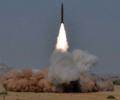
As the test was conducted, a top Pakistani military official said the country had developed a "strong nuclear deterrence capability" and was fully capable of thwarting any aggression.
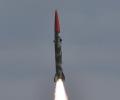
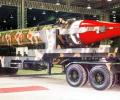
Pakistan on Tuesday successfully test-fired a short-range surface-to-surface ballistic missile Hatf III (Ghaznavi), capable of carrying nuclear and conventional warheads to a range of 290 kilometres, that could cover parts of India.

This was the third launch of a ballistic missile in as many weeks.
'This strike has certainly enhanced your image.' 'Otherwise, people would have called you a damp squib, capable of doing nothing except talking big.'
The short range ballistic missile has a range of 290 km.
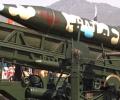
"We estimate that Pakistan now has a nuclear weapons stockpile of approximately 170 warheads. The US Defense Intelligence Agency projected in 1999 that Pakistan would have 60 to 80 warheads by 2020, but several new weapon systems have been fielded and developed since then, which leads us to a higher estimate," the Nuclear Notebook column published in the Bulletin of the Atomic Scientists on September 11 said.
For the world and India, one of the most enduring challenges of the times is for Pakistan's nukes to be neutralised, before they are ever used by the State, their sponsored non-State actors or any rogue elements from the many terror tanzeems dotting Pakistan's unstable landscape, says Lieutenant General Kamal Davar (retd).

'Any conventional conflict could trigger a nuclear war with results that neither India nor Pakistan could survive easily.' >A revealing excerpt from Shuja Nawaz's The Battle For Pakistan: The Bitter US Friendship And A Tough Neighbourhood.
'It is ironic that General Rawat, an infantry officer who the government chose because of his expertise in counter-insurgency, has made his first bold statement in the realm of warfighting and mechanised operations,' points out Colonel Ajai Shukla (retd).

'With two nuclear neighbours, how likely is it for our armed forces to battle in a contaminated environment that could include nuclear, biological or chemical attacks by the adversary?' 'Are we prepared for the threat?' Brigadier S K Chatterji (retd) explains the meaning and significance of Operation Vijay Prahar.
 © 2026 Rediff.com - Advertise with us - Disclaimer - Privacy Policy - Sitemap - Feedback - About us - Terms of use - Grievances